MDCAT not required for MBBS abroad: since 5 October 2026, Pakistani students no longer need to pass MDCAT to take admission in a foreign medical or dental university. The Pakistan Medical & Dental Council (PM&DC) decided this on 14 September 2026 and published the notice on 5 October. The exemption removes one admission test. It does not remove the licensing exam you will face when you come back to practise in Pakistan.
If you have been asking "is MDCAT required for MBBS in China" or in Russia, Georgia or Azerbaijan, the short answer now is no, as far as PM&DC is concerned. The universities set their own entry rules, and PM&DC's other rules for foreign study are still there. This guide explains what changed, what did not, and what to do next. If you read our earlier explainer, Do you need MDCAT for MBBS abroad, treat this post as the update.
What does the PM&DC notice say?
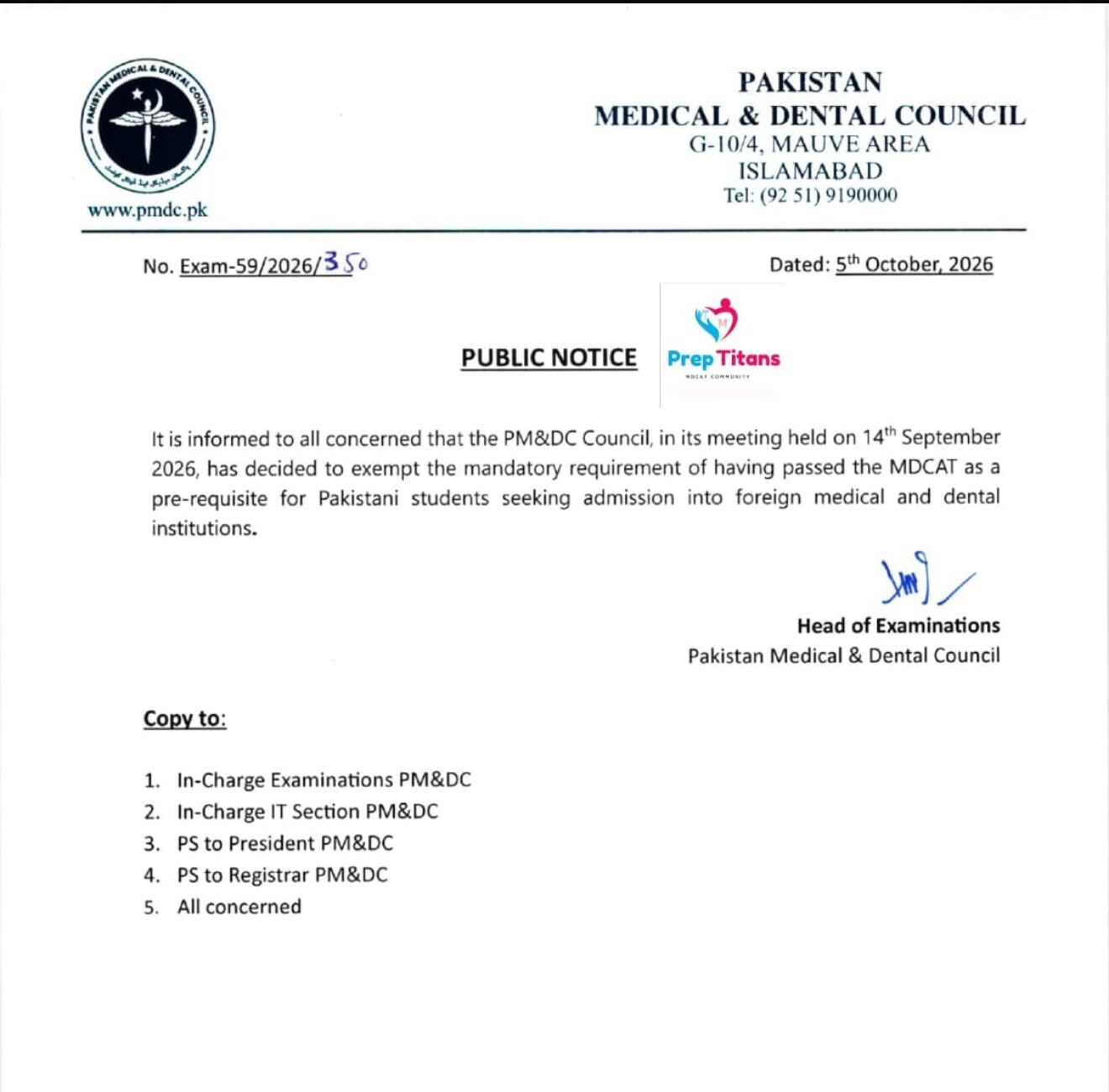
The notice is numbered Exam-59/2026/350 and dated 5 October 2026. It was issued from the PM&DC office at G-10/4, Mauve Area, Islamabad, and signed by the Head of Examinations. The operative text reads:
"It is informed to all concerned that the PM&DC Council, in its meeting held on 14th September 2026, has decided to exempt the mandatory requirement of having passed the MDCAT as a pre-requisite for Pakistani students seeking admission into foreign medical and dental institutions."
Three things are worth reading carefully in that sentence.
- It covers Pakistani students seeking admission into foreign institutions. It says nothing about Pakistani colleges.
- It covers both medical and dental programmes.
- It exempts one requirement, the MDCAT pass. It does not mention FSc marks, registration, or the licensing exam.
The notice itself gives no reasons and no transition rules. That matters for students who were already in the middle of an application, which we cover below.
Why did PM&DC drop the MDCAT requirement?
The notice does not explain the decision. Pakistani media reports fill in the background. ProPakistani, Express Tribune and APP all carried the news on 5 and 6 October. According to those reports:
- PM&DC President Dr Rizwan Taj told Dawn that a parliamentary committee had recommended that students going abroad should not be required to clear MDCAT.
- The Senate Standing Committee on National Health Services had questioned why MDCAT was needed for foreign admission.
- A Senate sub-committee had questioned the legal backing of the rule and argued that MDCAT could not stop students from joining weak foreign institutions.
- The committee side suggested stronger regulation of substandard foreign institutions and publishing a list of those that fail the required standards.
We could not find the original Dawn article, so the quote from Dr Taj is as relayed by these outlets. The reasons above are the reported ones, not wording from the notice.
What was the rule before 5 October 2026?
PM&DC's policy guidelines for foreign undergraduate admission have applied since session 2024-25. A public notice around 14 May 2026 repeated the main conditions: at least 50% in MDCAT, at least 60% in FSc Pre-Medical, and online registration on the PM&DC student portal (srf.pmdc.pk). The same guidelines on pmdc.pk also set out the programme and licensing conditions listed in the next section.
Those rules were criticised in June 2026 in the Senate committee discussion mentioned above. The October notice is the result.
Before vs after 5 October 2026
| Item | Before 5 Oct 2026 | After 5 Oct 2026 |
|---|---|---|
| MDCAT pass for foreign admission | Required (50% in the May 2026 notice) | Not required |
| FSc Pre-Medical minimum | 60% in PM&DC guidelines | Not mentioned in the notice. Check pmdc.pk |
| Student registration (srf.pmdc.pk) | Required before going abroad | Not mentioned in the notice. Check pmdc.pk |
| University recognition and listing | Institution must be on the approved list | Not changed by the notice |
| Licensing exam on return | National Registration Exam required | Still required, per media reports |
| Transfer to a Pakistani university mid-course | National Examination Board assessment | Still required, per media reports |
| MDCAT for Pakistani medical and dental colleges | Required | Unchanged |
The "Not mentioned" rows are honest uncertainty. The notice exempts MDCAT only, and the reports we read say the rules on recognising foreign degrees and registering to practise remain. We did not find an updated PM&DC guideline document after 5 October, so read the live pages on pmdc.pk before you pay any fee.
What is still required after the exemption?
Rules that PM&DC's published guidelines list
The policy document on pmdc.pk, written before the exemption, lists these conditions for foreign undergraduate study. Everything except the MDCAT line should be treated as live until PM&DC says otherwise.
- FSc Pre-Medical with at least 60% if you studied in Pakistan, or an alternative such as SAT-II or a foreign MCAT or UCAT route with the stated minimums.
- The institution must be on the ECFMG approved list. Check the World Directory of Medical Schools at search.wdoms.org and ECFMG's listing status for your school.
- The qualification must be in allopathic medicine from an institution recognised by the relevant regulator in the country where it sits.
- A PM&DC Student Registration Certificate, free of cost, through srf.pmdc.pk before you leave.
- A programme of at least 6,200 hours over five years, with at least 80% attendance.
- If the language of teaching is not English, at least six months of local language study before you go.
- A multiple entry and exit visa valid for the whole programme when you apply for the licensing exam.
- Passing the National Registration Examination (NRE) to get a licence.
The guidelines add that a candidate who fails to follow them becomes ineligible to sit the NRE. That is the sentence that should make you careful. Skipping the student registration is easy to do and expensive to fix later.
The exam you face after graduation
Graduates who want to work in Pakistan must pass PM&DC's registration exam for foreign graduates. Reports from 2025 describe it as two parts, NRE-I and NRE-II, with a pass mark of 60% in each part. Some 2026 reports use the name National Equivalence Board (NEB) exam for PM&DC's foreign-graduate exam, and an NEB sitting was scheduled for 12 September 2026. Media and PM&DC use the names loosely. We could not confirm the current pass mark or exact exam structure for 2026, so check pmdc.pk. Our guide to PMDC registration after a foreign MBBS walks through the process in detail.
Does the exemption affect students already studying abroad?
The notice does not say. None of the reports we read describe a transition rule. Reports quote a PM&DC official saying students studying abroad will not need to clear MDCAT, which suggests the exemption is meant to help them too. But "suggests" is not "confirms". If you are already enrolled, keep your registration paperwork, admission letter and passing records, and ask PM&DC in writing if your case is unclear. If you were told earlier that you were ineligible for the licensing exam because of a missing MDCAT, ask PM&DC whether that has changed before you assume it has.
What does it mean for MBBS in China?
For students asking "MBBS in China without MDCAT", the answer is that PM&DC no longer blocks you for lacking it. Chinese universities were never the ones asking for MDCAT. What they ask for is set by each university and by the Ministry of Education, and this is where the real work now lies.
- Pick a university on the Ministry of Education list for English-taught medicine. Our guide to how to verify PMDC-recognised universities in China shows the checks, and our MBBS in China hub lists the universities.
- Expect an academic minimum. On our university pages the usual figure for Pakistani applicants is 60% in HSSC or FSc with Physics, Chemistry and Biology, but each university sets its own number and some are higher.
- Check CSCA. The China Scholastic Competency Assessment is organised for the Ministry of Education and details are on csca.cn. Subjects differ by university. Nanjing Medical University, for example, names Mathematics and Chemistry for its MBBS notice, while others name Mathematics, Physics and Chemistry. On our data some universities require it and some do not. Read the CSCA exam guide and which universities do not require CSCA yet.
- Check English and Chinese language rules. Many English-taught programmes need no IELTS from Pakistani applicants, but some do. Some, such as Jilin University on our page, require HSK 4 before graduation even though teaching is in English. Hospital work in later years goes better with some Mandarin.
If your marks are low, the exemption helps, but it does not lower a university's own minimum. Our post on MBBS in China with low MDCAT marks covers that case, and the eligibility guide for Pakistani students lists the basics.
What does it mean for Russia, Georgia and Azerbaijan?
For anyone searching "MDCAT for MBBS in Russia Georgia", the position is the same. PM&DC no longer requires it, and the universities never did.
Russia
Entry is set university by university. Official 2026-27 pages show Sechenov University using a chemistry entrance test with a Russian language test, Rostov State Medical University using chemistry and biology, and Saint Petersburg State Medical University listing biology and chemistry for foreign applicants. Other universities, including one on our pages, admit on the academic transcript. Preparatory departments for foreign students are common. See our MBBS in Russia page for the universities we list.
Georgia
Foreign citizens who finished secondary school abroad can usually enter without Georgia's Unified National Exams, with the university's consent. Our Georgian university pages list FSc Pre-Medical with 60% and no IELTS for several universities. One news report says mandatory language levels (B1 for medicine) begin for foreign applicants from the 2027-28 year, which we have not confirmed with the ministry. Start with our MBBS in Georgia page.
Azerbaijan
Our Azerbaijan pages list FSc Pre-Medical with 60%, an age window of 17 to 27, and an English proficiency certificate from your last school. Azerbaijan Medical University's own dean's office document says foreign students first enter a preparatory department and become students after passing the end-of-year exam. We found no current 2026 admission page from the university, so confirm the details with it directly.
Who should still take MDCAT?
MDCAT not being required does not make it useless. Sit it, or keep your result, if any of these apply to you:
- You also want a seat in a Pakistani public or private medical college. MDCAT remains the entry test there.
- A scholarship or sponsor asks for an MDCAT or similar score. Check each call.
- You might want to transfer back to Pakistan later. Transfers still need the National Examination Board assessment, and a strong MDCAT history makes the case for admission easier to explain.
- You are not sure about your marks and want a fallback.
If none of these apply, you can put your preparation time into the things the universities do ask for: FSc marks, CSCA, language and documents.
Risks now that the filter is gone
The MDCAT rule was meant to discourage weak foreign admissions, even if the Senate sub-committee doubted it worked. Without it, the responsibility moves to you and your family. Watch for these:
- Choosing an unrecognised or weakly regulated university because it is cheap or "no test needed". The exemption says nothing about a university being good.
- Assuming every foreign degree is accepted in Pakistan. The recognition conditions above still apply, and PM&DC lists can change. Reports say the committee wants a published list of institutions that fail standards. Until one exists, check yourself.
- Failing the licensing exam. Graduates sit the same exam regardless of how they entered. Choose a school with strong clinical teaching and a programme that meets the 6,200-hour, five-year standard.
- Agents who say the rules are "all removed". Only MDCAT was exempted in the notice. Ask the agent to show you the PM&DC page. Our guide on how to choose an MBBS consultant in Pakistan lists the warning signs. Titans Abroad does not charge a consultation fee, but whoever you pick, verify the university yourself on pmdc.pk and the World Directory.
Checklist after the MDCAT exemption
- Read the notice on pmdc.pk and note the number, Exam-59/2026/350, and the date, 5 October 2026.
- Check the live PM&DC foreign-admission guidelines for FSc marks and any other current conditions.
- Register on srf.pmdc.pk for your student registration certificate before you travel, unless PM&DC says otherwise.
- Shortlist only universities that appear in the World Directory of Medical Schools and, for China, on the Ministry of Education list.
- Confirm the programme is at least five years and 6,200 hours of allopathic medicine.
- Check CSCA, HSK, English test and entrance exam rules on the university's own page.
- Keep an MDCAT result if you also want a Pakistani seat or a scholarship that needs it.
- Save PM&DC pages and notices as PDFs with the date, in case rules change again.
- Plan early for the National Registration Exam, including a multiple entry and exit visa for the whole programme.
Is MDCAT required for MBBS abroad? The honest summary
MDCAT is not required for MBBS abroad from 5 October 2026. That is a real change, and it widens your choices. It does not shorten the course, lower the licensing exam, or change a university's own admission rules. Verify the university, keep your paperwork clean, and check pmdc.pk for any later notice. For a wider comparison of the options, see our MBBS in Russia vs China guide.
Frequently asked questions
Is MDCAT required for MBBS abroad after 5 October 2026?
No. PM&DC's notice dated 5 October 2026 exempts the mandatory MDCAT pass for Pakistani students seeking admission to foreign medical and dental institutions. The council decided this on 14 September 2026. MDCAT is still the entry test for medical and dental colleges inside Pakistan.
Is MDCAT required for MBBS in China?
PM&DC no longer requires it, and Chinese universities have their own rules. These usually include a minimum FSc or HSSC mark, and sometimes CSCA, an English test or HSK. Check the admission page of the specific Ministry of Education listed university.
Do I still need 60% in FSc?
The notice does not mention FSc marks. PM&DC's earlier guidelines asked for 60% in FSc Pre-Medical, and most university pages on our site also use 60% as a minimum. Treat 60% as the safe working figure and confirm on pmdc.pk and with your university.
Do I still need to register on srf.pmdc.pk?
The notice does not change student registration, and the earlier guidelines require a free PM&DC Student Registration Certificate before you go abroad. Failing to follow the guidelines can make you ineligible for the licensing exam. Register unless PM&DC says otherwise.
Will my foreign degree be accepted in Pakistan without MDCAT?
Degree acceptance depends on the university's recognition, the programme length and hours, and passing the registration exam. The MDCAT exemption does not change those. Graduates who want to practise must pass PM&DC's registration exam for foreign graduates.
I am already studying abroad. Does the exemption apply to me?
The notice gives no transition rule. A PM&DC official was reported saying students studying abroad do not need MDCAT, but the notice itself is silent. If your eligibility for the licensing exam was in doubt because of MDCAT, ask PM&DC in writing.
Can I transfer to a Pakistani medical college without MDCAT?
Not automatically. Reports say students who want to transfer to a Pakistani university midway through their studies must pass the National Examination Board assessment, which PM&DC holds twice a year. Admission to a Pakistani college as a first-year student still uses MDCAT.
Should I still sit MDCAT if I plan to go abroad?
Yes, if you want a Pakistani seat as a backup, if a scholarship asks for it, or if you may want to return and transfer. If you are certain about going abroad, you can skip it and focus on your university's entry requirements.