If you are applying abroad this year, the Ministry of Foreign Affairs (MOFA) step has just changed. A circular dated 14 October 2026 says MOFA has moved consular document attestation online and will email you an electronic certificate instead of stamping paper. This guide explains what that means for a student, which documents need MOFA at all, and which destinations want an apostille instead of an embassy stamp.
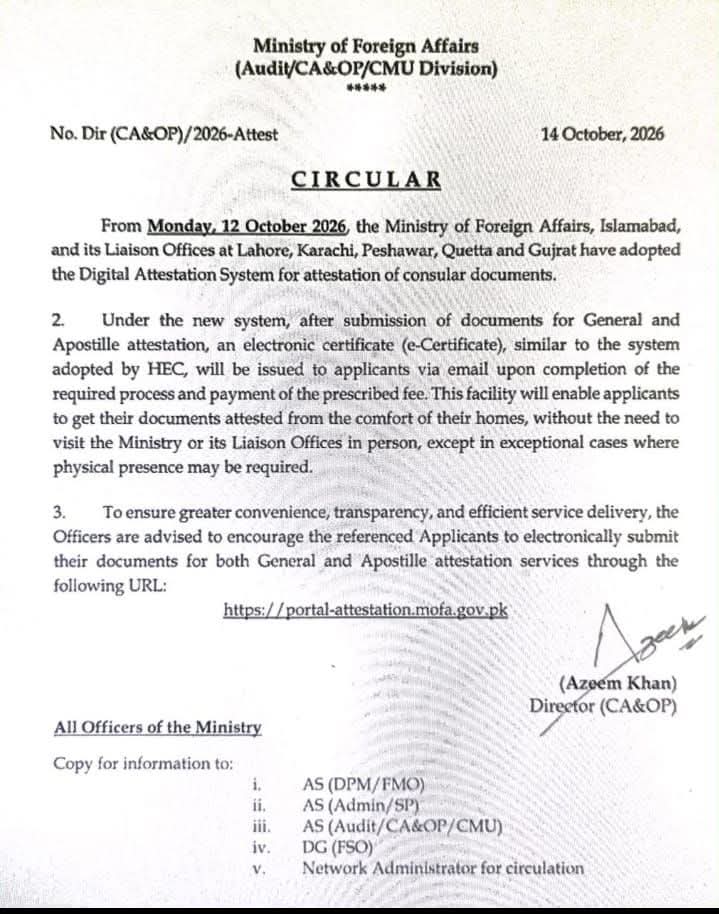
What changed on 12 October 2026
The circular is numbered Dir (CA&OP)/2026-Attest. In plain terms, it says that from Monday 12 October 2026, MOFA Islamabad and its Liaison Offices at Lahore, Karachi, Peshawar, Quetta and Gujrat have adopted a Digital Attestation System for consular documents. After you submit a document for general attestation or for apostille, an electronic certificate (e-Certificate) is emailed to you once processing and fee payment are complete. The circular compares this to the system HEC already uses for degrees. You do not need to visit an office, except in exceptional cases. The portal named in the circular is portal-attestation.mofa.gov.pk.
Here is what I could and could not check. The circular details above come from the circular itself. I could not find any newspaper report on it yet, and the MOFA pages I tried to open (the portal, the apostille site and the consular services page) returned server errors when I fetched them. So I cannot describe the portal screens, and I am not going to guess at them. Open the portal and the MOFA consular services page yourself before you plan anything around it.
Two earlier MOFA notices matter for context. A notice dated 5 March 2026 said the government had temporarily suspended access to several portals, including the Apostille Online Portal, for cybersecurity reasons. A later notice said that from Monday 27 July 2026, apostille attestation would no longer be entertained without prior online registration at apostille.mofa.gov.pk. The October circular is the next step in the same direction: less paper, less queuing.
General attestation vs apostille
These are two different routes to the same goal, which is making a Pakistani document believable to a foreign office or university.
- General attestation is the older route. MOFA confirms that the stamp and signature on your document (for example the HEC or IBCC stamp) are genuine. Then the embassy of the destination country adds its own stamp. It is a two-stage chain, and it is still what countries outside the Hague system ask for.
- An apostille is a single certificate from MOFA that is accepted directly by every other country that is a party to the Hague Apostille Convention. There is no embassy stage afterwards.
Which one you need depends only on where the document will be used. Ask two questions. Is the destination a Convention party that has not objected to Pakistan? If yes, apostille. If not, general attestation followed by the embassy. Then ask whether your university or visa office has its own extra rule, because some do.
Pakistan and the Hague Apostille Convention
Pakistan acceded on 8 July 2022. According to the Hague Conference (HCCH) status table, last updated 30 June 2026, the Convention entered into force for Pakistan on 9 March 2023. MOFA's own announcement gave the same date and said Pakistan would accept foreign apostilles from then on without further attestation by MOFA or Pakistani missions abroad.
Issuing Pakistani apostilles came later, because legislation and systems had to be put in place first. The Pakistan Embassy in Norway, citing MOFA, gives 17 May 2024 as the date MOFA Islamabad began issuing apostille certificates. Another report refers to the process starting on 8 July 2024 at MOFA and its liaison offices, and the current fee schedule is dated from that day. If you see two dates in different places, that is why.
There are two catches in the status table. Pakistan made a reservation that the Convention does not apply between Pakistan and India. And eight states objected to Pakistan joining: Germany, Poland, the Czech Republic, Austria, Finland, the Netherlands, Greece and Denmark, according to the Dutch treaty depositary database, with none withdrawn. For those eight, the Convention does not operate with Pakistan, so a Pakistani apostille is not the route to count on. This matters a lot for anyone applying to Germany.
Which study destinations accept an apostille
The table below uses the HCCH status table for the date each country became a party. The last column is what I found about practice for Pakistani documents. Where I found no embassy statement, I say so. Always check the embassy and your university, because a country being a party does not stop a university from asking for something extra.
| Destination | Hague party (in force) | What I could verify for Pakistani documents |
|---|---|---|
| China | Yes (7 Nov 2023 for China) | Visa centre notices say Pakistan and China are covered from 7 Nov 2023 and that Chinese missions in Pakistan stopped consular legalisation from 21 July 2025. Apostille from MOFA is the route. Notice sourced from the visa application centre, so confirm with the embassy. |
| Russia | Yes (31 May 1992) | Party, no objection to Pakistan found. I found no Russian embassy statement on student documents. Ask your university. |
| Germany | Yes (13 Feb 1966), but objected to Pakistan | Convention does not apply with Pakistan. The German Embassy in Islamabad certifies copies of study documents for university applications and says HEC cross-attestation is not required. Check the embassy page for current steps. |
| Italy | Yes (11 Feb 1978) | The Islamabad embassy says that from 18 November 2024 it accepts only documents apostilled by Pakistan, with Italian translation. Study visa lists also ask for a CIMEA certificate. |
| Hungary | Yes (18 Jan 1973) | Party, no objection found. No embassy statement found. For Stipendium Hungaricum, HEC's notices decide which documents you submit and when. |
| Turkey | Yes (29 Sep 1985) | Turkish Karachi Consulate General note says apostilled Pakistani diplomas and transcripts are accepted without further legalisation; some translations may need notarisation. |
| South Korea | Yes (14 Jul 2007) | Party, no objection found. I found no embassy statement. Check the embassy and the university. |
| Japan | Yes (27 Jul 1970) | Party, no objection found. The embassy checklists I found for student visas do not mention an apostille. Follow the university and embassy list. |
| United Kingdom | Yes (24 Jan 1965) | Party, no objection found. I found no official statement on what UK universities ask. Follow the university and UKVI instructions. |
| United States | Yes (15 Oct 1981) | Party, no objection found. Check the admissions page for what each school wants. |
| Saudi Arabia | Yes (7 Dec 2022) | Party, no objection found. I found no official Saudi statement on Pakistani education documents, and community guides still describe the older chain. Confirm with the embassy. |
| UAE | Not on the HCCH table | Embassy route. The UAE Embassy in Islamabad says Pakistan-issued documents must first be attested by Pakistan MOFA, and offers a digital attestation service (original paper document needed, most requests 2 to 3 business days). |
| Qatar | Not on the HCCH table | Qatar became an HCCH member in September 2026, which is a different thing from joining the Apostille Convention. Treat it as an embassy route. |
| Malaysia | Not on the HCCH table | Embassy route. I found no embassy statement for students, so confirm with the Malaysian mission and your university. |
| Georgia | Yes (14 May 2007) | Party, no objection found. Georgia's foreign ministry says documents from Convention states need only an apostille. Check each university. |
| Azerbaijan | Yes (2 Mar 2005) | Party, no objection found. I found no embassy statement. Check the embassy and the university. |
The HCCH table lists 130 contracting parties. Check the live HCCH table before relying on any row, since it changes.
What must happen before MOFA
MOFA does not attest your degree on its own authority. It confirms the stamp of the body that verified it. For students the chain starts earlier.
- Matric and FSc (or A Levels and O Levels): IBCC attestation or equivalence first. See our guide to IBCC attestation and equivalence. IBCC checks documents that carry its QR code online (IBCC verification page) at no charge, and its manual verification fee is listed as Rs 600 per certificate.
- Bachelor, master and other degrees: HEC attestation first. HEC moved to a fully online, paperless degree attestation system from 11 May 2026, with an electronic certificate you download from your dashboard. The fee reported for it is Rs 3,000 per document (degree, transcript, provisional certificate or equivalence letter). Check the HEC degree attestation page for the current amount.
- Other documents such as police character certificates and medical reports have their own issuers. See police character certificate and medical report.
The whole chain is laid out in our overview of IBCC, HEC and MOFA attestation. Keep the order: IBCC or HEC first, MOFA after. One source describes MOFA as refusing documents that have not been pre-verified, so do not try it the other way round.
Step-by-step: applying online
MOFA has not published, in anything I could open, a screen-by-screen guide for the new portal. What is documented is the apostille registration process from the 27 July 2026 notice, plus the e-Certificate outcome from the October circular. The steps below stick to those.
- Finish IBCC or HEC attestation. Keep the issued certificates and download any electronic versions.
- Create an account on the MOFA portal (portal-attestation.mofa.gov.pk for the Digital Attestation System; the apostille site was the registration site in the July notice).
- Enter your personal details and attach both sides of your CNIC.
- Create an application, choose general attestation or apostille, and upload your documents.
- Courier or hand over originals only if the portal tells you to. The circular says no visit is needed, but I could not find a statement on whether originals must be posted for every case.
- Pay the official fee through the payment method the portal offers.
- Wait for the email. The circular says the e-Certificate is emailed once processing and payment are done. Approval and processing updates also come by email, per the July notice.
- Download the e-Certificate and keep the original PDF. Do not edit it or print it from a screenshot.
Fees
The only official fee schedule I could confirm is the apostille schedule effective 8 July 2024, repeated in MOFA's attestation SOP: Rs 3,000 per personal or educational document, Rs 4,500 per legal document and Rs 12,000 per commercial document. I found no new fee notice with the October circular. Treat these as the last known figures and read the amount on the portal before paying. Courier companies and agents add their own charges, and those are not MOFA fees.
Separate bodies charge separately. HEC's attestation fee, IBCC's fees and an embassy's fee are all additional to MOFA's. For a student with a degree and two transcripts going to an apostille country, three HEC fees and three MOFA fees can add up quickly, so count documents before you apply.
How long it takes
I found no official processing time for the digital system. A search snippet from MOFA's May 2026 SOP says documents are processed within two hours or before office closing time, but the text sat in the general attestation section and I could not confirm it applies to apostille or to the new portal. Do not plan your visa deadline around it. For embassy steps, the UAE Embassy in Islamabad says most digital attestation requests finish in 2 to 3 business days. Build a few weeks of margin into your timeline, as in our 12-month application plan.
What the e-Certificate looks like and how it is checked
I could not see a sample, so I will not describe the layout. The circular says it works like HEC's electronic certificate. HEC's version is a PDF issued from the portal that anyone can verify on the commission's website. For apostilles, a MOFA service catalogue entry says validity can be checked online using the apostille number or QR code. Expect the same pattern for the digital certificate: a reference number or QR code that a university or embassy can enter on a MOFA page. Ask your university how it wants to receive it, because some admissions offices accept a PDF with a verification link while others want a printout.
Cases that may still need a visit
The circular allows exceptions but, in the text I have, does not define them. Before the circular, a MOFA service catalogue said legal documents required a physical visit even though other documents were applied for online first. That is the likeliest category to stay physical, but it is my reading of an older document and not an official statement about October. If your document is unusual, such as an old handwritten certificate or a court paper, check the portal notice or call the consular section before travelling.
If your documents were attested the old way
I found no MOFA statement that cancels documents attested before 12 October 2026. Apostilles are generally valid with no expiry unless the underlying document expires, per the service catalogue. HEC has said previously issued attestations remain valid and verifiable online, according to the reports on its May 2026 system. A reasonable reading is that your paper attestation stays usable, but the receiving university or embassy decides. If an embassy asks for re-verification, see the IBCC FAQ on embassy re-verification requests. If you have time, ask your destination which format it will accept before paying to redo anything.
Mistakes to avoid
- Sending documents to MOFA before IBCC or HEC has attested them.
- Assuming an apostille works everywhere. Germany objected to Pakistan, and the UAE, Qatar and Malaysia are not on the Convention list.
- Paying agents or unofficial websites for the "portal". Use only the mofa.gov.pk addresses.
- Ignoring a university's own instructions. Some want a PDF with a verification link, others may want paper, so ask.
- Counting documents wrongly and paying fees twice.
- Letting names differ across CNIC, passport and degree. A spelling mismatch can stall every step, and visa officers notice it. See the student visa rejection reasons guide.
- Waiting for the portal to be perfect. It is new, so expect delays and check notices.
Checklist
- Destination country and university rules checked in writing.
- Apostille or embassy route decided from the HCCH table and the embassy page.
- IBCC and HEC attestation finished, certificates downloaded.
- CNIC both sides scanned clearly.
- Documents scanned in the right format and size, as the portal states.
- Fee amount read from the portal, receipt saved.
- e-Certificate PDF saved in two places.
- Translations arranged if the embassy asks for them.
- Remaining items checked against the scholarship documents checklist and the English proficiency certificate and MOI letter guide.
Frequently asked questions
Do I still have to go to the Foreign Office?
According to the 14 October circular, no, except in exceptional cases. The circular does not define those cases in the text I have, so check the portal notice.
Is the e-Certificate legally the same as the stamped paper?
The circular presents it as the output of the official system, so it replaces the stamp. Whether a given embassy or university accepts a PDF is their call. Ask before you apply.
Which one do I choose, general attestation or apostille?
Apostille if the destination is a Convention party that has not objected to Pakistan. General attestation plus the embassy stamp otherwise. If your university states a preference, follow it.
Does the UAE accept an apostille?
The UAE is not on the HCCH status table as of 30 June 2026. The UAE Embassy in Islamabad says Pakistan-issued documents must be attested by Pakistan MOFA before it attests them, so use the embassy route.
What is the official fee?
The last confirmed MOFA fee schedule is Rs 3,000 for each personal or educational document, effective 8 July 2024. Confirm on the portal, since I found no new notice.
My degree was attested by HEC before May 2026. Do I redo it?
Reports on HEC's new system say earlier attestations remain valid and verifiable. A LinkedIn post claims otherwise, but it is not an official statement. Check the HEC site if your destination asks for a new one.
Can an agent apply for me?
The portal needs your CNIC and an email you control. I found no official rule on representatives for the new system, so apply yourself where you can and read the portal terms first.
How do I check if a certificate is real?
Use the reference number or QR code on the certificate and enter it on the official MOFA verification page. Do not trust a link someone sends you.